The data center is built on camera, then run on it
A hyperscale site is a construction project for a year and a half, then a locked box for twenty. Cameras now measure the poured concrete, catch the missing hard hat, spot the loiterer at the fence and watch the cage door.
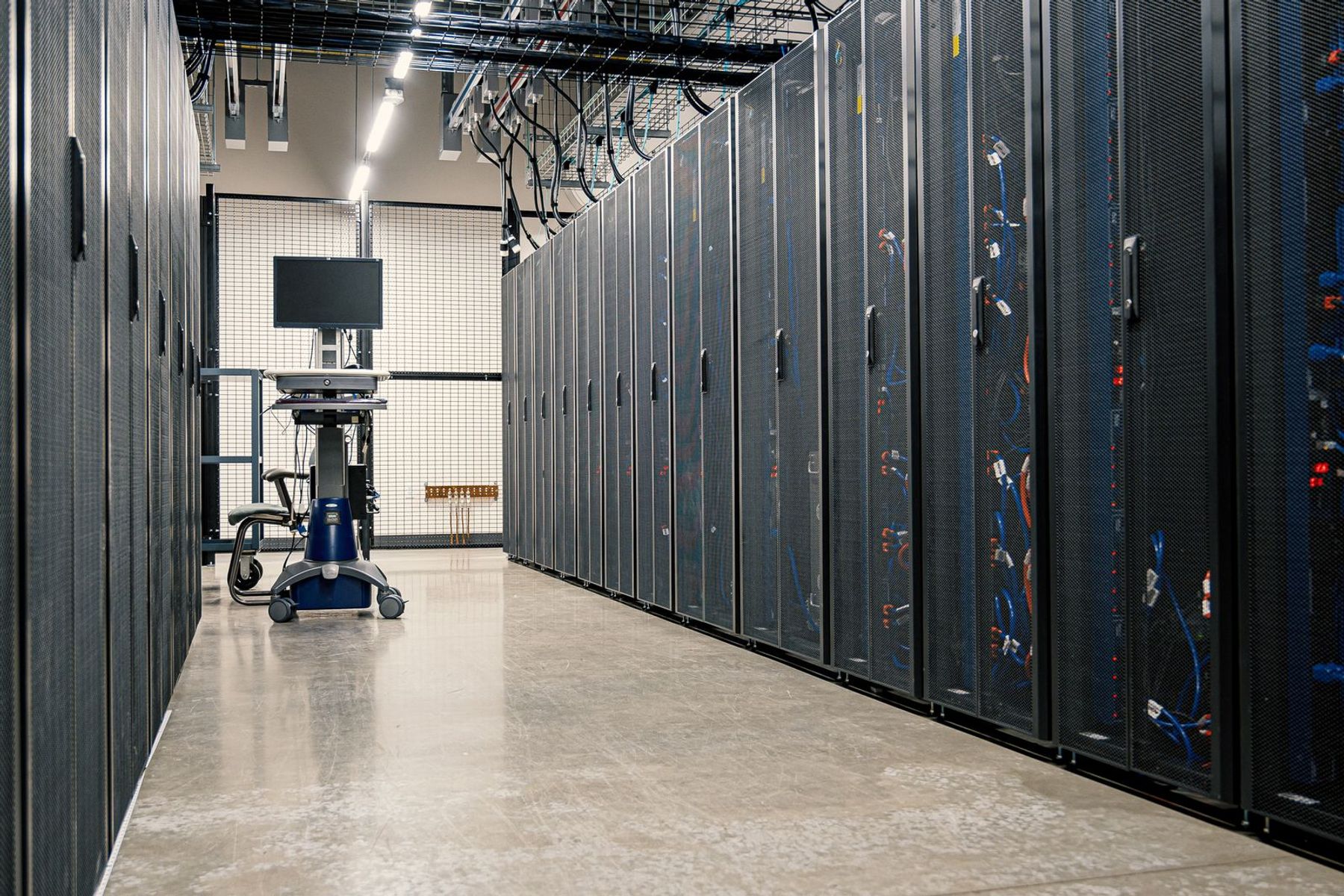
For eighteen months or so a hyperscale data center is a construction site with a few thousand people on it. Then it becomes a building almost nobody is allowed inside, and stays that way for twenty years. Both phases run on cameras, and over the past two years the software behind those cameras has started to do the watching.
Progress, measured off a hard hat
The construction side came first, because that is where the money is. Doxel mounts a 360 camera on a hard hat, has a superintendent walk the floor, and lets computer vision compare the footage to the plan. The company says its software "analyzes the video and measures work-in-place," broken down "by component, system, and schedule" (Doxel). QTS, a data-center operator, is on the customer list. Nikki Lux, a schedule coordinator there, gives the reason in one line: "Doxel is valuable because it's objective. It consistently gives owners confidence we can deliver on time" (Doxel).
Buildots sells a similar idea and has built a data-center page around it. The headline is "Build at the speed of technology," the promise is operational status in "months, not years," and the company says the projects it has tracked represent 9.93 GW of delivered capacity (Buildots). Digital Realty and Intel appear among its customers. Abbey Mumford of Mortenson says the value "lies in its ability to provide near real-time visibility into our progress and pace" (Buildots).
OpenSpace covers the job "from breaking ground through commissioning," pairing 360° ground capture that is "automatically mapped to your floor plan" with drone imagery for the earthworks, and cites a deployment on a "$1.2B+ hyperscale campus" (OpenSpace). Its customers report an "8x Increase in safety observations" once walks are captured and searchable (OpenSpace). All three record a walk and reason about it afterwards. A fixed camera that runs all night is a different product, sold by different companies, and the two are starting to meet on the same sites.
The apprentice with a phone
Navigate.ai is the newest entrant and the odd one out. Its launch post is dated May 26, 2026, and frames the problem as labour: "We are building the AI copilot for the physical world. This shortage of builders is compounding" (Navigate.ai). The company calls itself "the trusted AI copilot for field teams everywhere," and its whole data-center pitch is one sentence: "Build faster and more safely as new apprentices enter the field" (Navigate.ai).
The camera here is a phone or a pair of glasses. Navigate describes its capture product as "A second pair of eyes" that "ensures your team consistently and visually captures all features, conditions, and quality," and says it has processed more than a billion frames (Navigate.ai). The product page promises "Issues caught while you're still onsite" (Navigate.ai). Navigate publishes no data-center customer yet and no safety numbers. It is four months old and should be read that way.
The fence, then the gate
Once the fence goes up, the problem shifts from measuring work to keeping people out, and the fixed-camera companies take over. Spot AI's construction page leads with "Jobsite cameras that do more than record" and lists what its agents look for: trespassing and unauthorised access, after-hours loitering, theft-related behaviour, missing PPE, zone intrusion, and subcontractor accountability (Spot AI). Brian Cavanaugh, CEO of VigilanteX, says on Spot AI's homepage that the system "brings that same clarity to construction and critical infrastructure" (Spot AI).
The company's Remote Security Agent comes in "pole-mounted or wall-mounted" form and delivers what Spot AI calls Contextual Talkdowns. "It can distinguish between a delivery person and a potential intruder, responding accordingly," and it "adjusts its response from a gentle reminder during business hours to a firm warning after hours," escalating from lights to a verbal warning to a police request (Spot AI). Spot AI names no data-center customer. What it publishes is a construction product and a perimeter product, and a data-center build needs both.
Hakimo sells the remote-monitoring layer on top. Its AI "monitors your site 24/7 without fatigue, detecting intrusions in real time," with human operators behind it and a claimed median response of six seconds, and it lists access-control monitoring as a use case (Hakimo).
Inside the hall
The finished building has rules of its own. Ambient.ai's data-center page states them without decoration: "Data centers enforce strict access controls across cages and server rooms to prevent unauthorized entry and insider risk," and "Data centers operate large perimeters where early detection of intrusion is critical to prevent threats from reaching the infrastructure" (Ambient.ai). It ties video to access-control events to validate badge activity and flag unauthorised presence in secure zones, and claims its Access Intelligence product eliminates "95%+" of false alerts, with "90%+" of alerts resolved in under a minute (Ambient.ai). TikTok's U.S. Data Security unit is a named customer. Rehan Reddy, a principal on its converged security technology team, says: "With Ambient.ai, we are able to push the boundaries beyond industry standards to protect US data centers with a proactive AI solution" (Ambient.ai).
I would not overstate how joined-up this is. The progress tools and the security tools are sold by different companies to different buyers, and the handover from a Buildots walk to an Ambient cage alarm is a handover between vendors, with all the lost context that implies. What has changed is that each phase of the building's life now has a camera product that reasons about what it sees. Not long ago the one camera I remember on a build like this was the time-lapse rig for the marketing team.