The camera stopped being a sensor. It became a colleague.
For eighty years the camera watched and waited for a person to look. The new generation sees, reasons, and acts. Here is why that is the biggest change in the history of the device, and why it starts now.
About 540 million years ago, life on Earth got eyes. Within a geological blink, nearly every major animal body plan appeared. The biologist Andrew Parker argued in In the Blink of an Eye that vision was the trigger: once an organism could see, hunting got efficient, hiding got necessary, and evolution sped up. Fei-Fei Li, who built ImageNet, has drawn the same line to machines. Give software eyes and you get a Cambrian explosion of what it can do.
I think about that every time I look at a camera on a warehouse wall.
Eighty years of watching
The first closed-circuit camera was built in Germany in 1942 to let engineers watch V-2 rocket launches from a safe distance. It did not record. It extended a pair of human eyes across a field.
Tape recorders in the 1970s gave us the first look-back: you could rewind a real event. Axis shipped the first IP camera in 1996 and video became network data. Then cloud storage and cheap sensors took the world from roughly ten million IP cameras in 2010 to about a billion today. Every store, plant, and loading dock has a feed you can open from your phone.
And yet, through every one of those eras, the camera stayed a sensor. All of the intelligence lived in the person watching. The device got better at showing you the past. It never got better at noticing.
What changed in 2024
Between September 2023 and March 2024, the major labs made vision a first-class input to their models. A machine could finally read a scene the way it reads a sentence: what is here, what changed, what happens next. Spot AI shipped its first Video AI Agents on top of that shift in October 2024, alongside a $31 million round led into the company by Qualcomm Ventures.
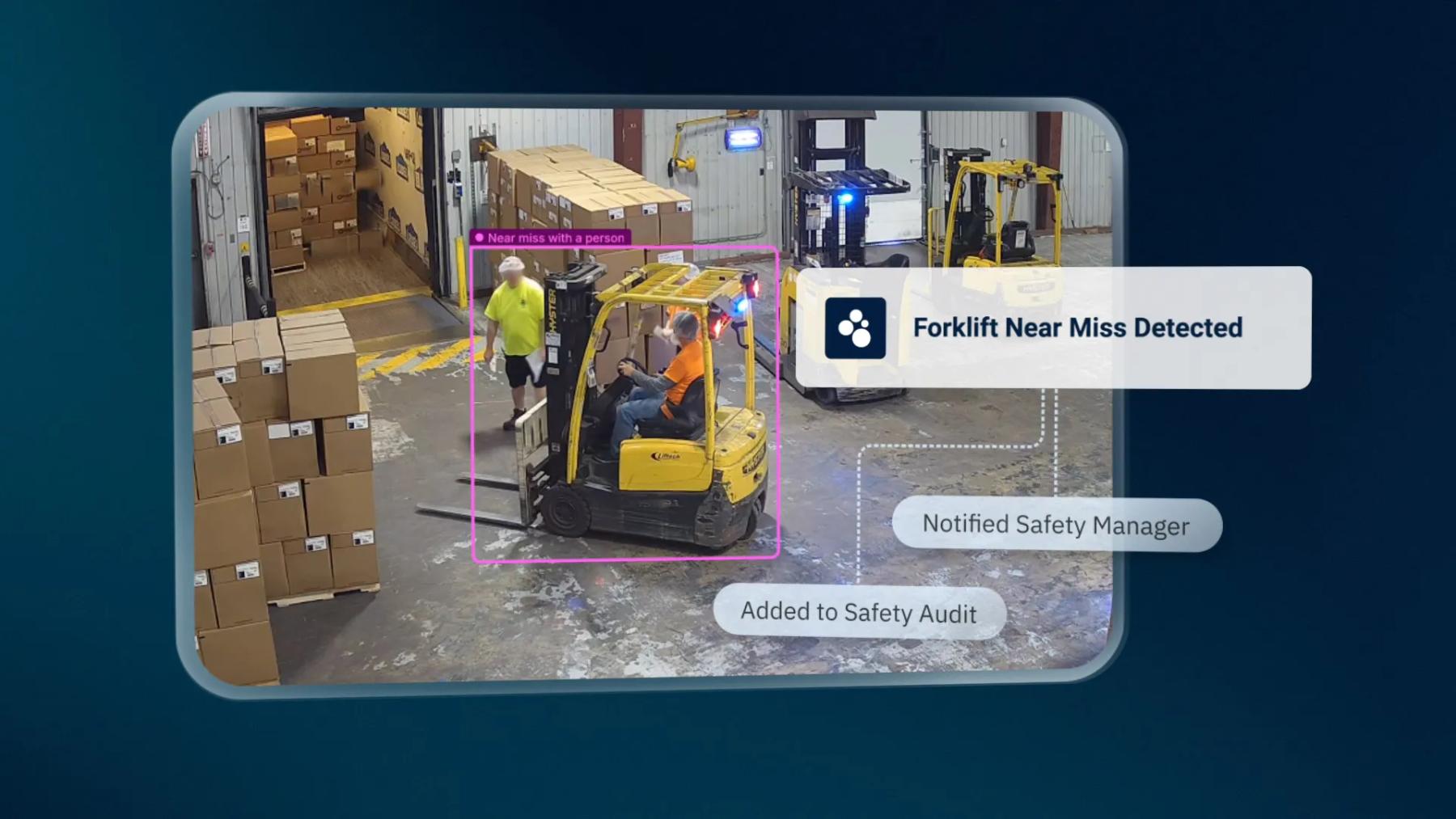
The claim at the time was simple. An agent "sees your physical space, uses advanced AI to reason about what's happening, and takes actions in real-time." Alerting a supervisor. Turning on a light. Stopping a machine when someone is in the wrong place.
Having cameras that talk back to you changes everything.
That line is from Leo, who runs safety at Primex Farms, a pistachio processor in California, in Spot AI's published account of the deployment. Before, his camera system lived on a local network. If he saw something, it was because he was on site. Now the system notifies him with a picture and he decides in seconds whether it matters.
Why "colleague" is the right word
A sensor produces data. A colleague produces judgment, and takes responsibility for the next step. The difference shows up in how customers describe the systems. At Unique Industries, a party-goods manufacturer with a million square feet in Virginia, the director of safety calls the agents his "second and third shift safety personnel." At a self-storage operator, the head of virtual operations says the system is "like another team member." Nobody talks about their NVR that way.
There is a harder version of the argument. We are on pace to have more digital eyes than human eyes on this planet. Once those eyes are interpretable by a foundation model, every physical workflow that used to require a person to look and decide becomes software-addressable. Security is the first wedge because the bar is low: today's systems drown operators in false alarms, and a response time of a few seconds is a vast improvement on a human. Operations follow. Robotics comes after, trained on what the fixed cameras learned.
The honest caveat
None of this is finished. Perception is still the bottleneck. Occlusion, bad lighting, and cameras that drift out of focus break more demos than anyone admits. The agents that work today are the ones matched to problems where eighty-percent accuracy and a two-second delay are already a leap.
But the direction is set. The camera has spent eight decades getting better at showing us what happened. It has just started telling us what is happening, and doing something about it. That is not an upgrade. That is a new species.