Cameras as digital workers: the Cambrian explosion of AI for the physical economy
Eighty years ago the camera let engineers watch a rocket from a safe distance. It is about to become a worker. An essay on how vision unlocks physical AI, why the utility function already favours security, and what it takes to build for it.
I have been fascinated by how AI enters the real world, from our screens into every realm of physical life, and it was not until I watched Fei-Fei Li's Stanford lecture online that the pieces connected in my head.
About 540 million years ago, Earth went through the most dramatic acceleration of biological complexity in its history. The Cambrian Explosion produced virtually every major animal body plan within a geologically brief window of 20 to 25 million years. Andrew Parker, in In the Blink of an Eye, argued that the evolution of the eye was the primary catalyst. Before vision, organisms lived in a world of chemical gradients and touch. The moment light-sensitive organs became image-forming eyes, predation became efficient, camouflage became necessary, and the arms race of evolution accelerated.
Dr. Li, who built ImageNet, has drawn the parallel to artificial intelligence. She argues that we are watching a technological Cambrian Explosion in which machine vision is catalysing an unprecedented diversification of what AI systems can do. Just as biological eyes turned passive organisms into active agents that navigate and manipulate their environments, digital eyes are turning passive computing systems into agents that perceive, reason about, and act on the physical world.
By 2030 the world will hold more digital eyes, in IP cameras, mobile sensors and autonomous-vehicle arrays, than human eyes. That vision-native infrastructure is the substrate for the next generation of physical intelligence. Traditional computer vision answered narrow questions ("is this a person?"). Vision-language models bridge perception and natural-language reasoning. Add an action decoder and an agent can see a scene, reason about its context ("a hazardous spill near the exit"), and execute a response. World models will push further still. Yann LeCun has said AI needs to train on real-world video and spatial data to get anywhere near superintelligence.
The key takeaway is that perception is the bottleneck that gates autonomy. We are already on pace to have more digital eyes than human eyes. Once those cameras are interpretable by foundation models, every physical workflow that historically required a human to look and decide becomes software-addressable. What follows is my attempt to lay out how this permeates society and how organisations might be built to catalyse it.
Biological versus digital Cambrian explosions
- Catalyst. Biological: the evolution of image-forming eyes. Digital: modern VLM and VLA foundation models, moving toward world models.
- New behaviour. Biological: active predation and complex navigation. Digital: closed-loop autonomy and physical agents, with no humans needed to navigate the physical world.
- Outcome. Biological: diversification of phyla, skeletons, teeth. Digital: specialised physical AI agents, each specialising in tasks and outcomes.
- Primary data. Biological: sunlight and structural colour. Digital: high-definition IP video and multimodal inputs.
- Nervous system. Biological: early brains and centralised coordination. Digital: hybrid edge-to-cloud architectures with access to the physical world.
Section I: the history of cameras
Before we can understand the future of cameras we have to understand their history, because patterns repeat even when specifics do not.
The birth
CCTV, much like the biological eye, began as a necessity under extreme conditions. Siemens built it in Germany during the Second World War to observe rocket launches, under the supervision of Walter Bruch, an electrical engineer who would later invent the PAL colour television standard. The first CCTV cameras did not record. They transmitted something happening at a distance to human eyes watching from a distance, which mattered when the thing at a distance was a test launch. The camera was a direct extension of human vision.
Analog cameras
For the next 54 years CCTV evolved incrementally within analog signal processing. Cameras converted light to electrical signals sent over coaxial cable to monitors. Video tape recorders and then VCRs in the 1970s gave us the first form of time travel in surveillance: for the first time, people could go back in time on a real physical operation and review what happened. It was our first look-back. But all the intelligence stayed with the humans watching, tapes had to be rotated every 8 to 24 hours, and there was no metadata, no search and no remote access. You travelled to the data and watched it by hand.
The IP revolution
The internet reached cameras in 1996, when Axis Communications introduced the IP camera. This is the inflection where video moved from a closed circuit to a network-addressable endpoint. Video no longer had to travel over coax; it could be sent to any endpoint on the internet. Camera video truly became data that could, in principle, be streamed anywhere on the planet.
In principle, because video is an extremely rich data source and it took a decade for bandwidth and compression to catch up. There was another force too: the channel. Managed service providers, resellers and security integrators had built their expertise and infrastructure around analog. By 2010 analog cameras still outnumbered IP cameras eight to one.
Cloud cameras and the IP explosion
Sitting in 2010, you would have been sceptical of a 15-year-old technology with a 10 percent installed base. But over the next 15 years compression, bandwidth, chips and the channel all caught up, and the world went from ten million IP cameras to a billion. We all got our doorbell and pet cameras; every storefront and office got its own. You can watch these cameras from anywhere and search them almost like any other data. A few decades after our first look-back, we can now visit many locations at once from a laptop.
Sensors keep getting cheaper and form factors multiply: body cameras, dashcams, the cameras on cars built for autonomy. We are projected to pass ten billion cameras by 2035, a thousandfold expansion in 25 years. This was also the era in which cameras moved from a pure hardware sale to a software subscription for cloud access, search and early computer vision.
Autonomous visual systems, or video AI agents
Cameras give us look-back and real-time time travel to many locations, but they still leave it to us to watch the video and decide what should be done. Just as you can leave a coding agent running while you get a coffee, or send a research agent off to read for an hour, video AI agents finally put intelligence at the software layer that watches and acts on the video. It is as if you left the AI a standing instruction, "what would I do if I were there," and let it run across hundreds of locations on your behalf.
We are connecting brains to the eyes. The implications will be wilder than our imagination. That has been true for every species, and it will be true for AI. Every organisation can have AI watch everything it cares about, understand what it sees, and act on that understanding. That is the architectural foundation on which physical enterprise autonomy will be built.
The evolutionary phases, in short: the era of analog cameras (1940s); the dawn of IP cameras (1996); the cloud and SaaS era, IP cameras with software and basic analytics (2010s); and the autonomy era of video AI agents, autonomous visual systems (2025).
Section II: the software for brain-eye connections
Between September 2023 and March 2024, all three major labs made vision a first-class modality, with GPT-4V, Gemini and Claude 3. These systems showed open-vocabulary recognition, spatial reasoning, temporal understanding across video, and, critically, the ability to ground language in visual observation precisely enough to plan actions.
Years of research made that moment possible: Dosovitskiy's vision transformers, Radford's CLIP, Kaplan's scaling laws that revealed emergent capability in large multimodal systems, and many more. The architectural insight was that visual and linguistic representations could be aligned in one shared embedding space, so reasoning could integrate both.
Vision-language-action architectures then let us run closed-loop autonomy, seeing and acting together. The distinction is simple:
- A vision-language model (VLM) is perception plus reasoning in semantic space. Its outputs are captions, answers, scene graphs, plans, critiques and policy interpretations. Open loop, query and response. Static image or short clip. Latency budget of seconds to minutes.
- A vision-language-action agent (VLA) is closed-loop autonomy. Its outputs are actions: discrete or continuous, interventions, control commands, tool calls, actuation. Sense, act, observe. A continuous stream with long-horizon memory. Strategic and physical reasoning. Latency budget of 20 to 50 milliseconds.
Take a simple example. A person jumps your fence. In the analog era you can go back in time and try to identify them, after someone travels to the site and watches hours of tape; the response takes days or weeks. With an IP camera you can do the same from anywhere, still scrubbing for hours; hours to days. With cloud cameras you get an instant notification for every human near the fence, and a security operations centre staffs people to read those alerts and judge risk. With video AI agents, a combination of VLMs and VLAs, the system understands the context and reacts: it rejects the 99 percent of false notifications, and for the one that matters it locks the door, turns on the lights, issues a spoken warning within ten seconds, opens an incident and fires strobes at the intruder. The human work is the initial set-up, connecting other systems and actuators. Ongoing: none.
The VLM is the understanding layer that interprets what it sees and produces semantic representations. The VLA is the doing layer that selects actions, executes policy and integrates feedback. Eyes, brains and hands work together.
Hybrid edge-to-cloud architecture
This requires a hybrid design. Low-latency control and action, under one second, run on the edge. Long-horizon reasoning, temporal abstraction and generalisation run in the cloud.
The cloud VLM layer holds large models that excel at novel situations, contextual knowledge and high-level plans. Their size, often hundreds of billions of parameters, demands cloud deployment, and inference latencies of one to ten seconds are acceptable for strategic reasoning, at least for now.
Edge VLA decoders are compact models, often distilled from the large ones, that translate high-level plans into concrete commands at 20 to 50 milliseconds, or at worst under a second. They have to be reliable under resource constraints, because they sit in safety-critical loops.
The two have to work together, and deciding what runs where is the central design choice. More compute and memory at the edge is a large advantage for fast action cycles. Other components matter too:
- Sensor fusion: cameras, depth sensors, lidar, thermal and environmental sensors, integrated into one representation, with two-way links to access-control events (badge scans, door states), operational systems (ERP, MES), scheduling, visitor logs and maintenance work orders.
- Action grounding: mapping language-level intent ("prevent tailgating") to executable steps ("lock door, notify guard, start a 30-second evidence clip, open an incident ticket"). That needs tool schemas, policy constraints, environment state estimation and auditability.
- Policy distillation: transferring behaviour from large teacher models to compact student models that can run in real time while preserving what matters.
Two equations
The perception-action latency budget (PALB) is the maximum allowable time between sensory input and motor output. For manipulation it is 50 to 200 milliseconds; for many security applications today, one to two seconds is acceptable. Systems must meet the budget under worst-case conditions, and the budget is a sum:
PALB = t(capture) + t(encode) + t(infer) + t(decide) + t(actuate) + t(network)
The second equation describes the utility of any video AI agent, U(a), as a function of its perception accuracy P(t), reasoning depth R(t) and action latency L(t). Better perception and reasoning, and lower latency, mean more real-world applications and more value.
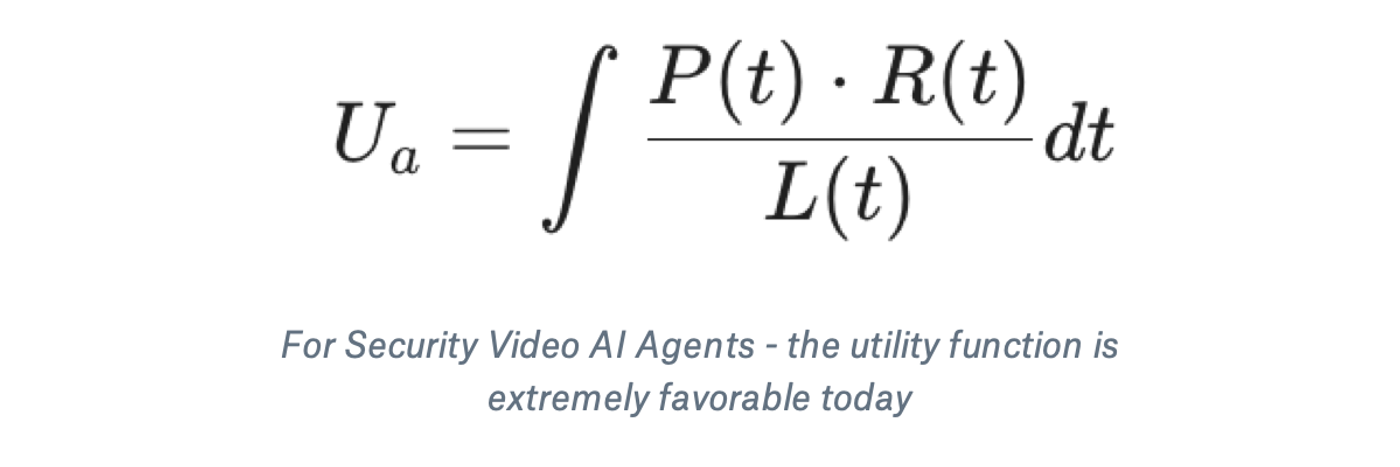
The applications disrupted first will tolerate lower performance across all three variables. As performance improves we move closer and closer to robotics.
Enterprises that engage early will have data-flywheel advantages, because these models learn and improve on their specific operations. The better the system performs, the more autonomy it can be trusted with, and more autonomy over time means lower cost and a durable advantage. The return goes beyond the first operational gains into strategic position for the autonomous-enterprise era.
Section III: video AI agents in physical security
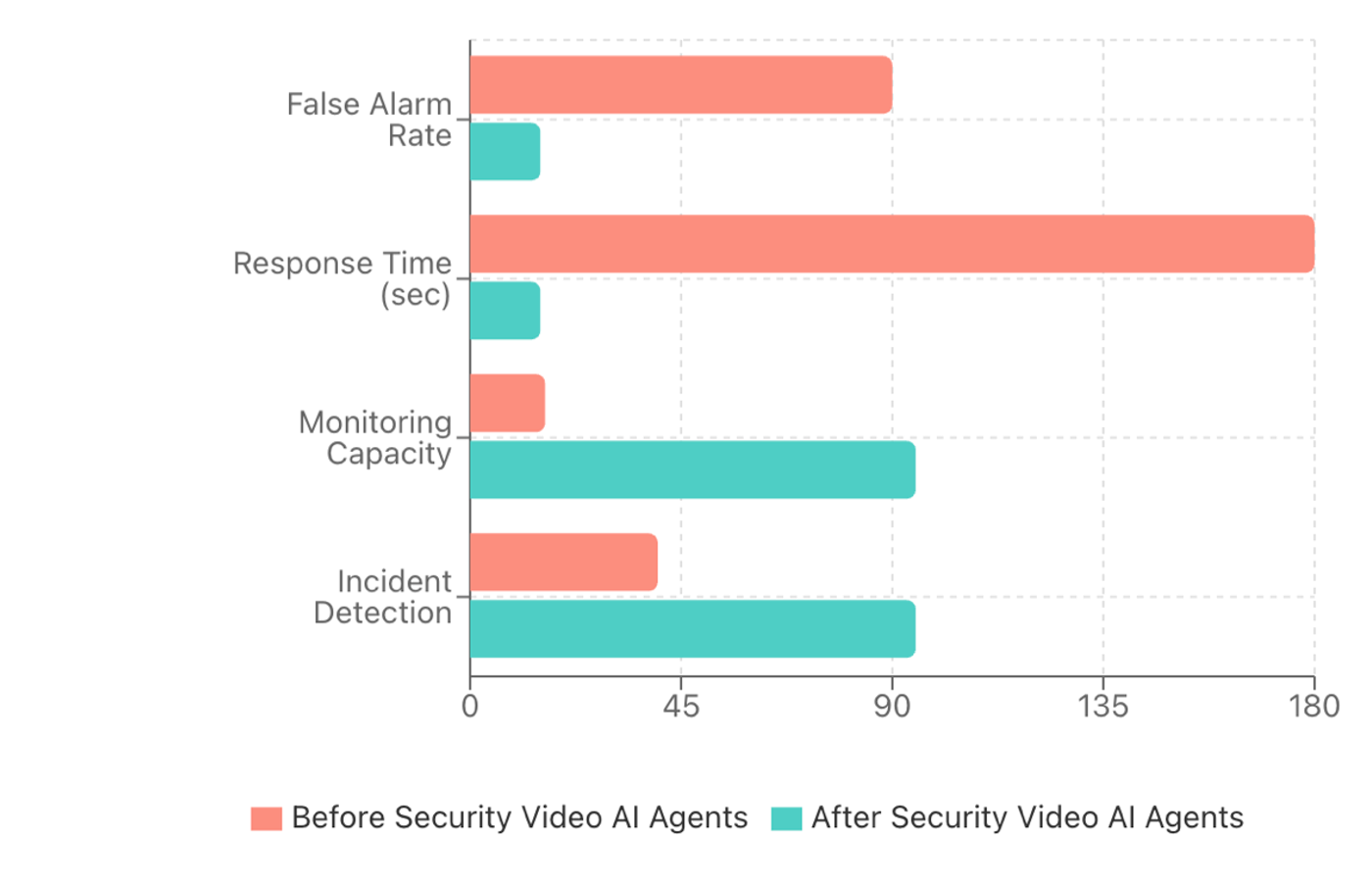
Enterprise security is shifting from passive recording to proactive, cognitive security. Traditional systems work on a simple model: sensors detect predefined conditions around people or vehicles, operators receive alerts, of which about 95 percent are false positives, and human judgement decides the response. The limits are inherent. A 95 percent false-positive rate breeds alert fatigue. Watching tens or hundreds of screens exhausts people and opens windows of vulnerability. Trained security staff are scarce.
A VLA-powered security agent performs contextual threat assessment by fusing visual data with internal enterprise APIs and issues responses without fatigue. It transforms the security operations centre. An enterprise stops employing people to watch screens and turns them into model supervisors who give the AI feedback, and that feedback trains the model to the specifics of the site.
The tenets of such an AI security guard:
- Open-set threat detection. Models must understand a wide range of threats and evolve with social engineering and new threat categories.
- False alarm reduction. The ratio should fall sharply over time; I think successful implementations can cut false alarms by 70 to 80 percent in the coming years.
- Cognitive load reduction. Cameras watch the environment and summon human attention only when required. SOC capacity or operator productivity can improve five to ten times as operators move from continuous observation to exception-based engagement.
- Average threat neutralisation time. Agents do not miss, do not sleep and respond within seconds, and response time decides outcomes.
Security is a high-value use case in which businesses already spend more than $100 billion a year. Incumbent systems have phenomenally low accuracy and rely on low-skilled labour, so both accuracy and reasoning are easy wins. And unlike robotics, a latency budget of a few seconds is entirely reasonable, and a vast improvement on human response. The utility function delivers very favourably today.
An AI security guard lowers the cost of conventional security and expands where security can be deployed at all. A $10,000 guard cannot be posted at every small business. A $1,000 AI guard can. Jevons' paradox will apply: as the technology gets cheaper and more capable, demand grows. Eventually we could all have an AI security guard for our homes.
Section IV: video AI agents for operations in manufacturing and construction
Security is the initial wedge, but the long-term value lies in the operational transformation of the physical economy. I believe these agents can lift a country's GDP by a few percentage points.
In manufacturing the shift is toward active process control. Cameras used to serve post-hoc quality assurance. VLAs enable real-time monitoring of standard operating procedures: whether a technician skipped a step, took too long, entered a no-contamination zone, missed a safety check, or moved the line before a part alignment was confirmed. Any process can now carry an AI observation layer that learns from thousands of hours of teams performing similar tasks across shifts and plants, suggests improvements, catches errors as they happen and summarises.
- Process optimisation through human-flow analysis: worker movement patterns reveal inefficiencies in layout, staging and sequencing, and time-in-motion measurement finds bottlenecks and tracks the effect of changes.
- Real-time SOP adherence: SOPs encode accumulated wisdom, yet adherence varies by shift and operator. Continuous monitoring replaces periodic audits.
- Safety protocol adherence: PPE compliance, safe equipment operation, hazard zones and ergonomics, monitored continuously.
Early implementations will succeed where the utility function meets the technology today: use cases fine with 80 to 95 percent accuracy that need detailed reasoning but allow higher latency, such as asynchronous coaching and end-of-day reports. In-the-moment, high-accuracy suggestions come over the next few years. Organisations that invest in early use cases will evolve faster to higher-value ones, with an army of agents trained and connected to their systems. Within a year or two of implementation I expect throughput improvements of 10 to 20 percent, quality defect reductions of 10 to 30 percent, OSHA incident reductions of 25 to 50 percent, and compliance documentation and audits at least 50 percent faster.
Construction has the same problems and some of its own. Sites suffer chronic visibility gaps; tracking progress against schedule, validating completion and ensuring specification compliance require manual inspection that scales poorly. Security agents apply directly, since theft and mishaps are common on sites, and the manufacturing operations agents transfer. Construction-specific agents add:
- Automated progress billing: comparing site conditions against building information models to assess completion objectively, turning a contentious negotiation into a measurement.
- Safety compliance automation: fall-protection monitoring, equipment safety zones, hazardous conditions and PPE, documented continuously, with no need for periodic inspection.
In states like California, cameras already act as patrol officers, issuing parking and speeding fines. With agents, local-government cameras will act like AI officers helping keep society safe. The use cases are endless and the value creation is massive. Think of all the jobs today's billion cameras, and the ten billion to come, can do for us.
Section V: video AI agents are the precursor to robotics
Fixed-camera VLMs are the primary training and sensory infrastructure for general-purpose robotics. The eyes and spatial understanding of an environment precede the hands. For a mobile agent to navigate an office or warehouse, it first needs a world model of the permanent fixtures, human behaviour patterns and the physics of that particular space.
The billion cameras hold 15 times the data stored on the entire public internet, and it must be harnessed to understand and improve how we work in the physical world.
The lack of three-dimensional spatial reasoning in visual models is a major constraint on autonomous systems. By training on billions of hours of footage from fixed enterprise cameras, combined with body cameras and movement sensors on humans, world models can learn spatial configuration (relative positions) and spatial compatibility (where objects can fit), both required to manipulate objects. Camera data is far cheaper, more abundant and more scalable than collecting robot trajectories through teleoperation. Fused, the two give an outside-in view of where an agent sits in the larger space and an inside-out, egocentric view of the world immediately around it. That socially aware spatial reasoning is what will make robotics powerful.
Beyond space, robots in human environments need to understand human behaviour. Most early deployments will pair humans and robots, and predicting human movement will be critical to co-existence. VLM systems trained on video develop implicit models of human behaviour that transfer to robots. The systems that analyse human workflow for optimisation today are building the behavioural models that will let robots work safely alongside people tomorrow. The enterprise that deploys video agents on its cameras now is building the map and the brain its future robots will use.
Section VI: how to build a winning company in this space
The perfect storm, from the facts above:
- Digital eyes now outnumber human eyes.
- Perception gates autonomy, and AI is getting very good very fast.
- With brains and eyes connected, wiring the system to physical actuators and digital workflows is easy, so the possibilities for automating work are endless.
- Since we are automating work, we have to define what work and for whom: think of video AI agents as digital members of the team.
- Utility is proportional to perception and reasoning and inversely proportional to latency. Some use cases work with today's models; the frontier moves toward harder perception and deeper reasoning at lower latency.
- The architecture needs edge and cloud working together; a hybrid with sufficient compute in both places wins.
- Physical security and operational optimisation are the industries that intersect today's utility function.
In three to five years these systems will operate above human efficiency and will be the connective tissue and training ground for modern robotics.
Where value accrues
As cameras become digital workers, the value of the work lies in the software. Even nature, after millennia of evolution, seems to reward the software, which is to say the brain. It happened with mainframes, where value moved from hardware to the operating system; with PCs, where it moved to Microsoft and the internet stack; and with smartphones, where the app-store ecosystem, some $2 trillion across the two leading stores, dwarfs hardware revenue.
Over the next decade camera licences will go from $10 to $15 a month to $100 or more as cameras deliver real work. That changes how companies should think about monetisation and the channel. A typical enterprise camera costs $1,000 to $2,000 and a $15 monthly licence yields only $900 of software revenue over five years, so the market behaves like a hardware business. At $100 per feed the software is worth $6,000 over five years against $1,000 of hardware, and the market, and the channel, start to behave like a software business. With software outstripping hardware by multiples, integrations, last-mile AI deployment and application customisation become the channel's value.
Start with use cases that provide three to ten times the utility of existing technology, then move outward to more complex problems. Perception will improve dramatically over the next two years and reasoning will get cheaper and faster, so use cases that were never feasible, or performed poorly, or were simply too expensive, will cross into the possibility frontier. Plug expected changes in perception, reasoning and latency into the utility function to see how it shifts.
A projection of the component trajectories: perception at 65 to 72 percent in 2025, 80 to 86 in 2026, 91 to 96 in 2027; reasoning at 45 to 52, then 62 to 72, then 82 to 93; speed at 30 to 38, then 50 to 62, then 75 to 92; composite utility at 35 to 45, then 62 to 77, then 89 to 98. By 2027 perception should match or surpass human level, reasoning should be twice today's, and latency should fall enough for real-time use cases with deep reasoning. Any team in this space should map its roadmap to customer requests, to the technology curve bending in front of us, and to the right use cases to monetise at each phase.
From cameras to digital workers
I made a bold assumption above: that companies will charge $100 per camera feed per month. How, and why? As cameras deliver meaningful parts of work, $100 is a fraction of what humans would cost for the same output. Security and operations are the examples above, and they extend to field service, traffic patrol, incident filing, documenting workflows and more. Over a 40-hour week these cameras cost under $0.65 an hour. Even if meaningful work is only ten hours a week it is under $2.50 an hour. No severance, no benefits, and you scale your digital workers up and down at will.
Jevons' paradox applies again. A $100 video agent will do far more work over time, so the cost per unit of output falls dramatically, and the more work it does, the more workers you deploy. Deploy cameras, connect eyes, brains and hands, train video AI agents, improve operations, justify more cameras. It is a self-sustaining cycle for years to come.
Distribution
The market already has a distribution channel: VMS providers, security resellers, camera manufacturers, integrators and installers. In earlier eras of the camera, innovation happened in hardware, and in the cloud era in both hardware and software. In this era it happens almost entirely in software; the only hardware gains will come from edge compute improving, and those will be distributed evenly. That creates the opportunity to partner with incumbents and resellers, pairing a novel technology with a distribution strategy that scales faster than ever.
The adoption cycle will look like this: 2025, the earliest innovators, with two to three times the utility of existing tools and the promise clear; 2026, early adopters, three to five times and the promise delivered; 2027, the early majority, when value really pops and a large share of enterprises and channels step in; 2028, the early majority expands and adoption becomes consensus; 2029, the late majority arrives, and data advantages, models trained on your own data, and processes built around AI decide who wins. By 2027 channel partners will have to become AI implementers for their customers, and the partners left behind will be replaced by an ecosystem that has understood that its value has moved from running cables to optimising last-mile AI for enterprises.
So the winning company has to have access to large amounts of video data, enough compute at the edge to maximise the utility function, a deep understanding of customer use cases and how they intersect the technology's evolution, the ability to build effective partnerships alongside traditional players, and a way to intersect the enterprise adoption cycle and the knowledge cycle. The company that does this can build enduring value.