The channel partner is becoming a forward-deployed engineer
The hard part of putting an agent on a camera is not the model. It is the knowledge in three people's heads at the plant. Someone has to get it out, and it will not be a software company.
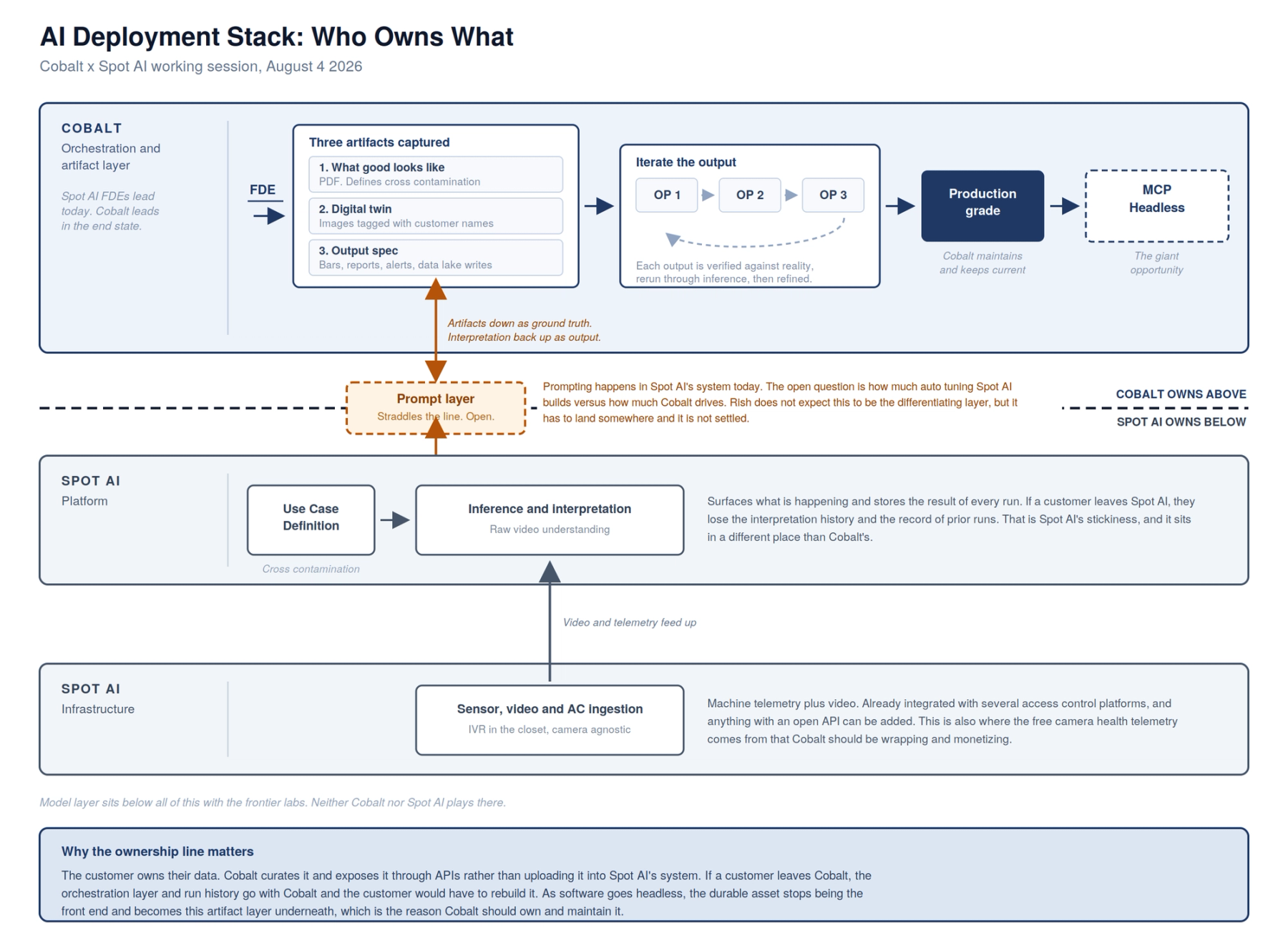
Every video agent we deploy needs three things from the customer before it is worth anything. A definition of what good looks like on that line, in that store, at that door. A digital twin: images of their site, tagged in their own vocabulary. And an output spec: what should happen when the agent sees something, a bar on a chart, a report, an alert, a row in a data lake.
None of that exists on paper. It lives in a few people's heads. Getting it into a form a machine can use is the work, and it is what customers actually pay for.
Who owns what
Here is how we draw the stack now.
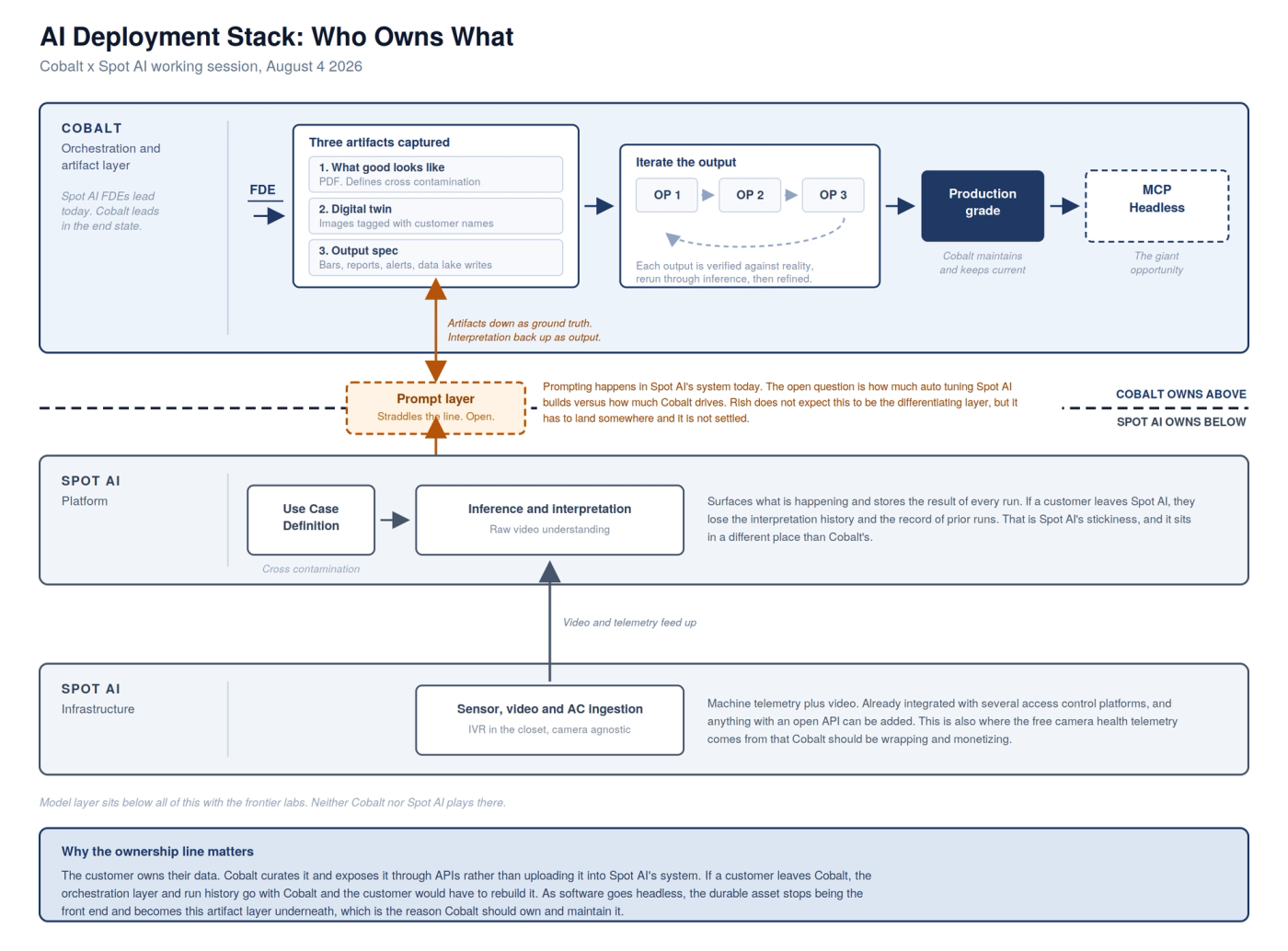
At the bottom sits infrastructure: the recorder in the closet, the cameras it talks to, the access-control feeds, the camera-health telemetry. Above it, inference: raw video understanding, the models, the record of every run. Both of those are ours. The model layer itself sits below all of it, with the frontier labs, and neither we nor our partners play there.
Above the line is the orchestration and artifact layer. Capturing the three artifacts. Iterating the output against reality until it is production grade. Maintaining it as the process changes. Eventually exposing it headlessly, through APIs, to whatever system the customer runs. That layer belongs to the channel.
The line matters because of where stickiness lives. If a customer leaves the partner, the orchestration layer and the run history go with the partner. If a customer leaves us, they lose the interpretation history our models have built on their sites. Both sides hold something real, in different places. Neither is a commodity.
Forward-deployed, by a different name
Palantir made the phrase forward-deployed engineer famous: an engineer who lives at the customer and builds the thing that makes the platform useful there. That is the job I have just described, and I believe it belongs to the channel.
The sequence we are running with partners is explicit. Our engineers lead the first deployments and the partner shadows. Then the partner leads, with us a support call away. The partners taking this seriously are hiring engineers and applied-AI product managers to do it, and getting their reps on real accounts, the kind where a head of manufacturing has already signed off on phase two and the controls team is in the room.
One thing we have learned on the way: charge for the build. Proving value for free reads as a demo. A paid build phase, with metrics agreed up front, reads as work, and customers treat it accordingly.
Why it is more than outsourcing
AI models improve with more high-quality data far more than with clever pre-training. The three artifacts are exactly that data. Every deployment a partner does well makes the platform smarter for the next one. Running cable never had that property.
There is also a mundane unlock hiding in the infrastructure layer. Our recorder already reports camera health and image quality, free. A partner who can show a customer which cameras are failing and which lenses are fogging has a reason to visit every quarter, and a data-backed refresh conversation instead of a sales pitch. That is the wedge for everything above it.
Who is already doing this
Cobalt, an integrator group built from 21 acquisitions, is one of the leaders. They are leading from the front on this model and working closely with us to build it, down to the whiteboard above. But it is not just them. Many of the large partners in our channel have reached the same conclusion on their own: they have to become AI deployment specialists for their customers, or watch that work go to someone who will.
For thirty years the integrator's margin came from hardware and labour. The next thirty come from judgement: knowing a customer's process well enough to encode it. That is a harder job and a better one, and it is the only way agents reach a million buildings. We cannot do it alone, and we should not try.